Running gear for Perth’s summer heat: what you actually need
Perth summers are long, dry and bright, and the right running gear for Perth’s summer heat makes a real difference to how a 6am run feels by the 5km mark. You don’t need a cupboard full of new kit. A few well-chosen pieces for sun protection, cooling and hydration will cover most runs from now until autumn.
This guide covers what to wear, what to carry and how to stay safe running in WA’s heat, with a few specific products we’ve checked for Australian price and specs.
Information checked October 2026. Prices change often, so check before you buy.
How hot does Perth get for running?
Perth Metro’s average maximum is 31.4°C in January and 31.7°C in February, and on average there are around seven to eight days of 35°C or more in each of those months, according to Bureau of Meteorology climate statistics. Even December and March average close to 30°C.
Last summer ran warm. The Bureau’s summer 2025-26 climate summary recorded a mean maximum of 31.6°C for Perth Metro, above the long-term average of 31.0°C, and Perth Airport hit 43.0°C on Christmas Day 2025.
Add Western Australia’s strong UV, and it’s easy to see why most Perth run clubs meet at sunrise or after dark from November onwards.
Sun protection: the non-negotiables
Cancer Council WA recommends sun protection whenever the UV index is 3 or above, so check the day’s sun protection times before you head out. Its five SunSmart steps adapt well to running.
Slip: UPF clothing and arm sleeves
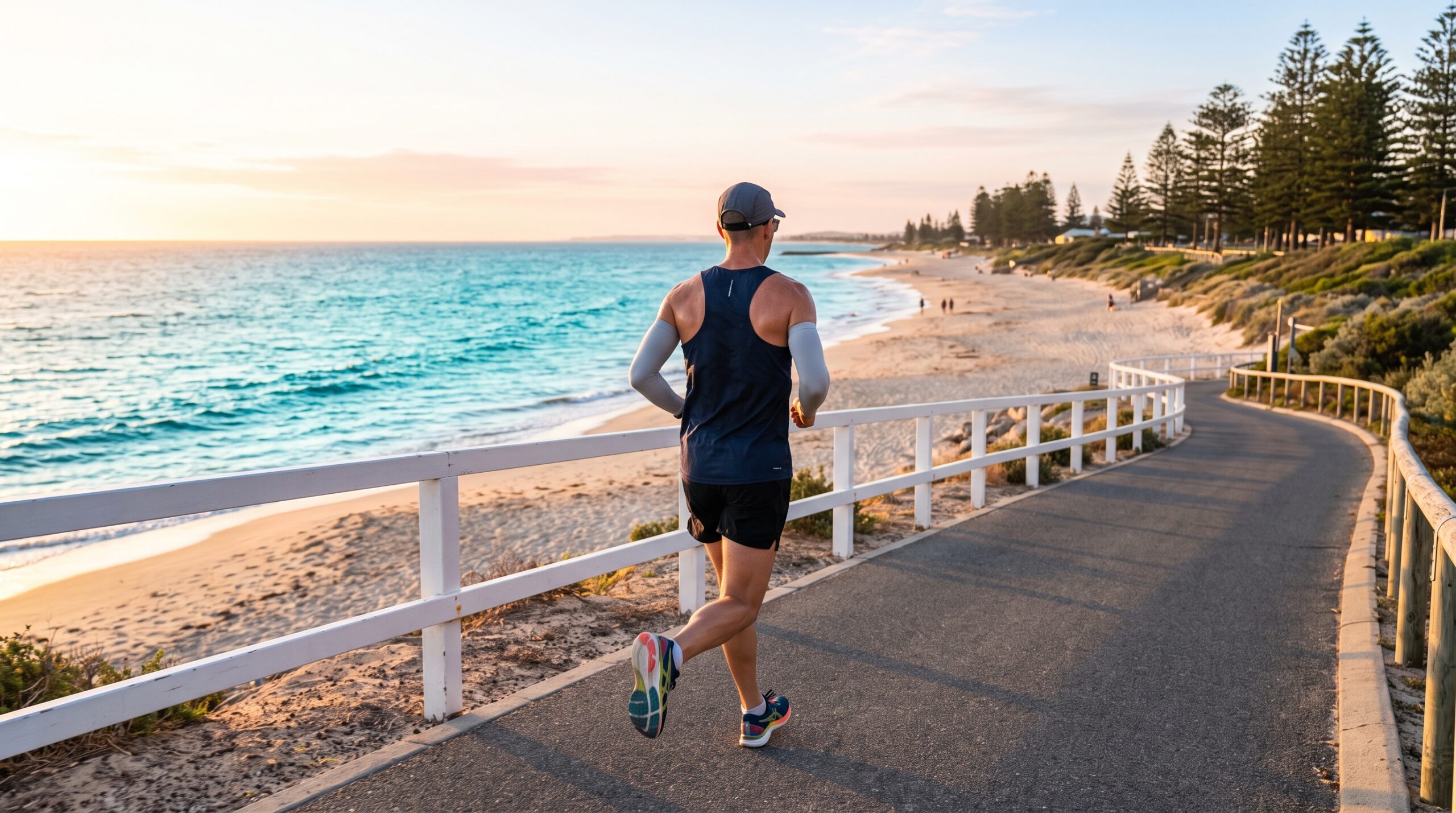
The more skin your clothes cover, the less sunscreen you have to rely on. For runners who don’t want long sleeves, UPF-rated arm sleeves are a popular middle ground. They pull on over a singlet or tee and can be pushed down or taken off if you warm up.
Look for a UPF 50+ rating, a cuff that stays put without pinching, and a light, quick-drying fabric.
Slop: sunscreen that survives sweat
Use a broad-spectrum, water-resistant SPF50+ sunscreen. Cancer Council WA advises applying it 20 minutes before you head out and reapplying at least every two hours. Don’t forget your ears, the back of your neck and the part in your hair.
Slap: a hat or cap
Most runners wear a cap because it stays on and keeps sweat out of your eyes. Cancer Council WA notes that a broad-brimmed, bucket or legionnaire hat protects more of your face, neck and ears. A legionnaire-style running cap with a neck flap is a good compromise; otherwise, be generous with sunscreen on your ears and neck.
Seek: shade and timing
The easiest way to beat the sun is to run when it’s lower. Schedule harder efforts for early morning or evening, and choose shaded routes where you can. Kings Park, Bold Park and parts of the Swan River foreshore offer more tree cover than the open coastal path.
Slide: sunglasses
Choose close-fitting, wrap-around sunglasses with an eye protection factor (EPF) of 10, as Cancer Council WA recommends. Running-specific frames with grippy nose pads won’t bounce or slide when you sweat.
Keeping cool: clothing and shoes for hot runs
- Lightweight, loose, moisture-wicking fabrics. Sports Medicine Australia recommends clothing that is light coloured, lightweight and loose fitting so sweat can evaporate.
- A light colour vs UV protection trade-off. Light colours reflect heat, while Cancer Council WA notes darker fabrics absorb more UV. A UPF-rated garment gives you tested sun protection regardless of colour.
- Breathable shoes. Knit and mesh uppers let heat escape. Pair them with thin, moisture-wicking socks to reduce blisters when your feet sweat.
- Anti-chafe balm. Heat plus sweat equals chafe. Apply it before you start, not after you notice.
- Cooling extras. Some runners swear by cooling caps, cooling towels or simply a wet buff around the neck. A post-run ocean dip at Cottesloe, Scarborough or Trigg does the job too.
Hydration gear: belts, bottles and vests
How much you carry depends on how long you’re out and whether there’s water on the route.
- Under 45-60 minutes: many runners don’t carry anything, but drink beforehand and know where the taps are. On a hot day, a small handheld bottle is still a good idea.
- About an hour or more: a hydration belt or handheld soft flask keeps fluid with you without much bounce.
- Long runs and trail runs: a hydration vest carries more fluid, plus your phone, keys, gels and a light layer. Vests spread weight across your shoulders and chest, so they’re often more comfortable than a belt for runs of two hours or more.
As a general guide, Sports Medicine Australia suggests drinking about two cups of water in the two hours before exercise, and 500-750ml of cool water or sports drink per hour for activity lasting over 60 minutes. Everyone sweats differently, so if you’re training for a long event, an accredited sports dietitian can help you build a plan.
Summer running gear compared
| Gear | Best for | Key specs | Price (checked Oct 2026) |
|---|---|---|---|
| SParms Original Arm Sleeves | Sun protection on arms without long sleeves | UPF 50+, ARPANSA accredited, sold as a pair | $44.99 |
| Salomon Active Skin 8 with flasks | Long road and trail runs | 8L, two 500ml soft flasks, 192g | RRP $179.99 (on sale for $90 when checked) |
| Handheld bottle or soft flask | Runs up to about an hour | Look for a hand strap and a pocket for keys | Varies |
| Wrap-around sunglasses | Glare off the coast and river | EPF 10, close fitting | Varies |
SParms Original Arm Sleeves
SParms lists its Original Arm Sleeves at $44.99 a pair. They’re rated UPF 50+ and accredited by ARPANSA, made from a microfibre and spandex blend with a double-layer cuff, and come in sizes from junior to XXL. The brand says its fabric “runs 2°C cooler than bare skin”; that’s the maker’s claim, so judge the comfort for yourself.
Verdict: a practical option for runners who burn easily on the arms or want to cut down on sunscreen top-ups during longer runs.
Salomon Active Skin 8 with flasks
The Salomon Active Skin 8 is an 8-litre running vest that comes with two 500ml soft flasks, weighs 192g and has room for a 2L bladder. Salomon Australia lists an RRP of $179.99, and it was discounted to $90 when we checked.
Verdict: more than you need for a 5km social run, but a solid choice for long runs, Perth Hills trails and anyone training for a half or full marathon.
Know the signs of heat illness
Heat illness can sneak up on experienced runners as well as beginners. Sports Medicine Australia advises stopping straight away if you notice:
- light-headedness or dizziness
- nausea
- unusual fatigue
- loss of coordination
- a stop in sweating
Confusion, odd behaviour or collapse are signs of a medical emergency: call 000. While you wait, move the person into shade, lay them down with legs raised and cool them by wetting their skin and fanning.
Two more tips: your body takes at least five days of training in hot conditions to start adapting, so ease into summer rather than going out hard on the first hot morning. And on extreme heat days, it’s fine to swap your run for a walk, a swim or a rest day.
Perth summer running checklist
- Run early or late, and check the UV index before you go.
- SPF50+ sunscreen, applied 20 minutes before you start.
- Cap or legionnaire hat, plus sunglasses.
- Light, breathable top or UPF arm sleeves.
- Water: handheld, belt or vest, depending on the distance.
- Anti-chafe balm and thin running socks.
- Tell someone your route if you’re running alone.
Frequently asked questions
What is the best time to run in Perth in summer?
Early morning is usually best, before the temperature and UV climb. Evenings work too, though footpaths and roads can hold heat after a hot day. Many Perth run clubs meet around sunrise for this reason.
Do I need UPF clothing for running?
You don’t have to have it, but it helps. UPF-rated clothing and arm sleeves give tested sun protection that doesn’t sweat off, so you rely less on reapplying sunscreen mid-run.
Should I wear a cap or a hat when running?
A cap is the most practical for running, but it leaves your ears and neck exposed. Cancer Council WA recommends broad-brimmed, bucket or legionnaire hats, so consider a legionnaire-style running cap or add extra sunscreen to your ears and neck.
How much water should I drink on a summer run?
Sports Medicine Australia suggests about two cups of water in the two hours before exercise, and 500-750ml per hour for sessions over an hour. Needs vary, so see an accredited sports dietitian if you’re training for a long event.
Do I need a hydration vest for a 5km or 10km run?
Usually not. A handheld bottle or belt is enough for most runs under an hour. Vests come into their own on long runs and trails where there’s no water on the route.
Gear up and find your crew
Summer running in Perth is better with the right kit and good company at 6am. Browse our pick of summer running essentials in the Perth Running Clubs shop, then find a free, friendly group near you in our Perth run club directory. Plenty of them finish with an ocean dip. For more training and gear advice, browse our runners’ guides.